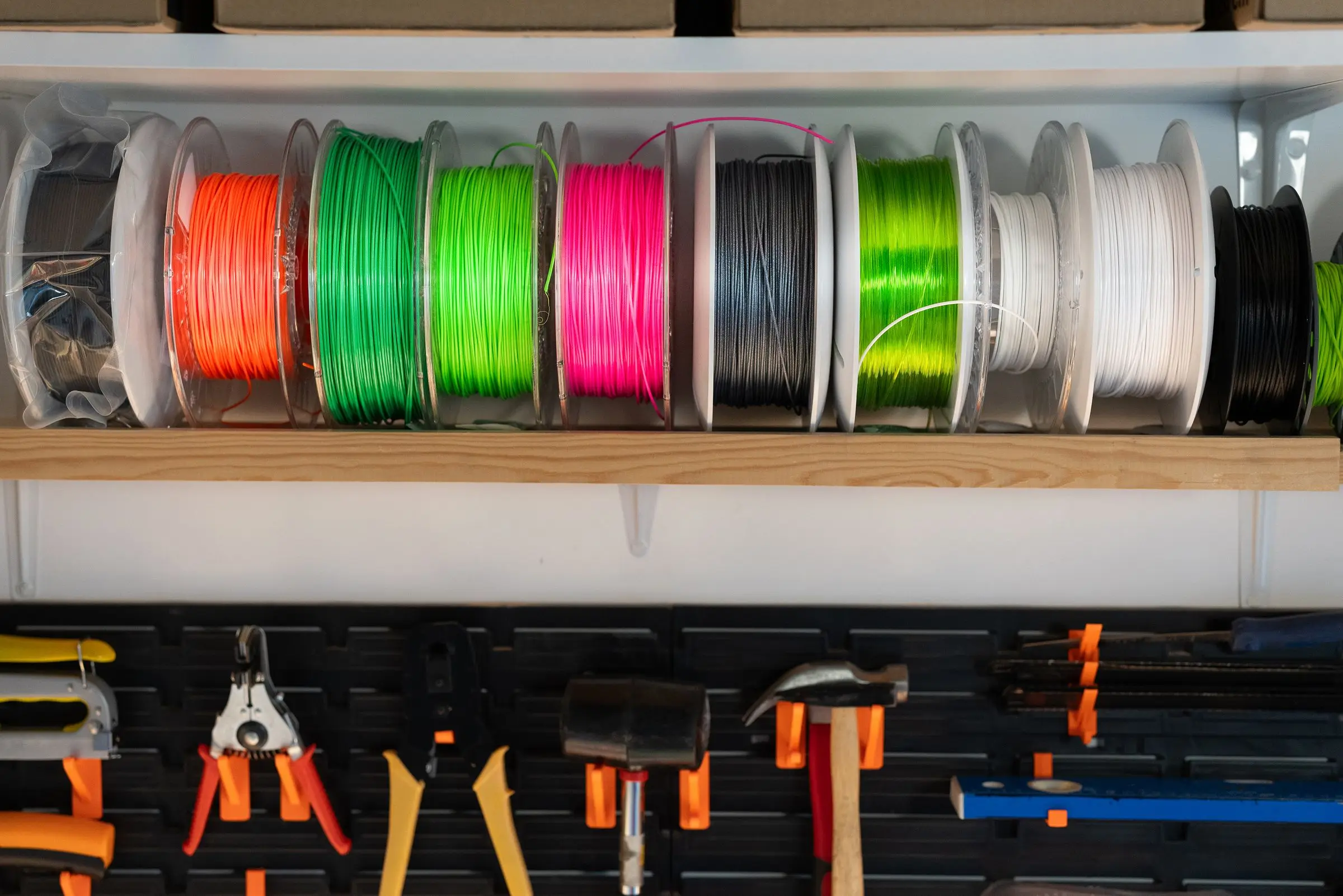
A 1 kg spool of 1.75 mm PLA holds about 335 m of filament, and the same kilogram in 2.85 mm holds about 126 m. The figure moves with density, so a kilogram of ABS runs to roughly 396 m while a dense carbon-fiber nylon can be under 300 m.
The formula
Filament is a long cylinder. Its mass is density times volume, and its volume is cross-section times length, so:
length = mass / (density x pi x (diameter / 2)²)
Keep the units consistent. With mass in grams, density in g/cm³ and diameter in centimeters, length comes out in centimeters.
Take Bambu Lab’s PLA Basic data sheet, which gives 1.24 g/cm³. A 1.75 mm strand has a radius of 0.0875 cm and a cross-section of pi x 0.0875² = 0.02405 cm². One kilogram of that PLA is 1000 / 1.24 = 806.5 cm³ of plastic. Divide volume by cross-section: 806.5 / 0.02405 = 33,530 cm, or 335 m. One meter weighs 2.98 g.
Meters per kilogram by material
The density column is the range across the maker data sheets in our temperature and property tables. Low density gives the long end of each length range.
| Material | Density (g/cm³) | 1.75 mm, m per kg | 2.85 mm, m per kg |
|---|---|---|---|
| PLA | 1.17 to 1.24 | 335 to 355 | 126 to 134 |
| PLA+ / tough PLA | 1.23 to 1.24 | 335 to 338 | 126 to 127 |
| PETG | 1.27 to 1.28 | 325 to 327 | 122 to 123 |
| ABS | 1.05 to 1.12 | 371 to 396 | 140 to 149 |
| ASA | 1.05 to 1.07 | 389 to 396 | 146 to 149 |
| TPU 95A | 1.22 | 341 | 128 |
| PA6 nylon | 1.12 | 371 | 140 |
| Carbon-fiber nylon | 1.06 to 1.40 | 297 to 392 | 112 to 148 |
| PC | 1.19 to 1.20 | 346 to 349 | 131 to 132 |
| PVA | 1.13 to 1.25 | 333 to 368 | 125 to 139 |
| HIPS | 1.05 | 396 | 149 |
Two rows deserve a second look.
PLA is not one number. Polymaker’s PolyLite PLA data sheet lists 1.17 g/cm³, which is 355 m per kilogram. Polymaker’s PolyTerra PLA data sheet lists 1.31 g/cm³, which is 317 m. That is a 12 percent difference in length between two PLAs from the same company, both sold as 1 kg. The often-quoted “330 m per spool” is fine for Bambu or Prusament PLA at 1.24 and wrong by a useful margin for either of those.
Carbon-fiber nylon is the widest row because the base polymers differ. Bambu’s PAHT-CF comes in at 1.06 g/cm³ and ColorFabb’s PA-CF Low Warp data sheet gives 1.40 g/cm³. At the prices these materials sell for, 95 m per kilogram is worth knowing before you compare spool prices. Bambu’s ABS data sheet at 1.05 g/cm³ sits at the other extreme: the most meters per kilogram of any common material.
None of this changes how much you can print. Parts are volume, and a kilogram of a lighter plastic is more volume. A kilogram of ABS at 1.05 g/cm³ is 952 cm³ of material against 806 cm³ for PLA at 1.24, so it makes 18 percent more part by volume. If you compare spool prices across materials, compare per cubic centimeter, which is what the print cost calculator does once you give it the right density.
Why 1.75 and 2.85 mm are so far apart
Length scales with the inverse square of the diameter. The ratio of cross-sections is (2.85 / 1.75)² = 2.65, so the thicker filament carries 2.65 times the plastic per meter and a kilogram is 2.65 times shorter. For PLA at 1.24 g/cm³ that is 7.91 g per meter against 2.98 g.
The practical upshot is that a length figure means nothing without the diameter next to it. “I have 50 m left” is 149 g in 1.75 mm and 396 g in 2.85 mm. Check your printer’s spec sheet if you are unsure which you have: Bambu Lab’s A1 specification page, for example, lists 1.75 mm as its filament diameter. If you run a 2.85 mm machine, make sure any calculator or slicer profile you use is set to match, because a 1.75 mm default will overstate your remaining length by that same factor of 2.65.
The square law also makes length sensitive to small diameter errors. Run the formula for PLA at 1.73 mm and 1.77 mm instead of 1.75 and you get 343 m and 328 m. A 0.02 mm deviation either way shifts the length by a little over 2 percent. That does not short-change you, since the spool is sold by weight and the mass is still a kilogram. It does mean that length is the least trustworthy way to track what is left.
Will the print finish? Weigh, do not measure
Slicers report both meters and grams for a job. Use the grams. The OrcaSlicer filament settings page is blunt about how the two relate: the diameter setting drives the extrusion maths, and the density setting is “for statistical purposes only”. In other words the slicer knows the volume it will extrude, and the gram figure is that volume times whatever density is typed into the profile. Leave a generic 1.24 in place while printing PolyTerra at 1.31 and every weight estimate reads 5 percent low.
So the check has three steps. Set the profile density from your filament’s data sheet. Weigh the spool. Subtract the empty spool.
A worked case. The slicer wants 212 g of PLA. A part-used Polymaker cardboard spool reads 395 g on the kitchen scale. The Polymaker FAQ gives the 1 kg cardboard spool as 140 g, plus or minus 7 g. That leaves 395 - 140 = 255 g of filament, or 248 g at the unlucky end of the spool tolerance. You have about 36 g to spare. Print it.
Now put the same 395 g reading on a Bambu Lab spool. Bambu does not publish a tare weight; the community measurements in our spool weight table put the reusable spool with its cardboard core at 233 to 250 g. That leaves 145 to 162 g. The print fails two-thirds of the way through. Same scale reading, opposite answer, and the only difference is 100 g of spool.
For reference, 255 g of 1.24 g/cm³ PLA in 1.75 mm is 255 / 2.98 = 85.5 m. You can convert in either direction with the filament length and weight calculator, which takes the density and diameter as inputs so the PolyTerra and 2.85 mm cases come out right.
Two habits make this painless. Write the tare weight on the spool with a marker the first time you finish one of that brand. And when a job is within 20 g or so of what is left, treat it as not enough: the purge line, any skirt or brim and a failed first attempt all come out of the same spool.
A filament runout sensor, which the A1 spec page lists as standard on that machine, turns a short spool into an interruption instead of a lost print. Without one, the scale is the cheapest insurance you own.